
Micro Technologies in Space

Microfluidics for space
Space is a challenging environment for liquid handling—microgravity eliminates the effects of gravity that normally drive fluid flow, while launch vibrations and pressure changes place extreme demands on hardware. Our microfluidic systems are specifically designed to overcome these obstacles. We use capillary forces, surface tension, and integrated pumps to move and mix liquids reliably in zero-gravity conditions. These systems support biological research, life-support monitoring, and in-situ resource utilization on space stations. Our solutions are compact, autonomous, and built to withstand the harsh conditions of launch and long-term orbital exposures.
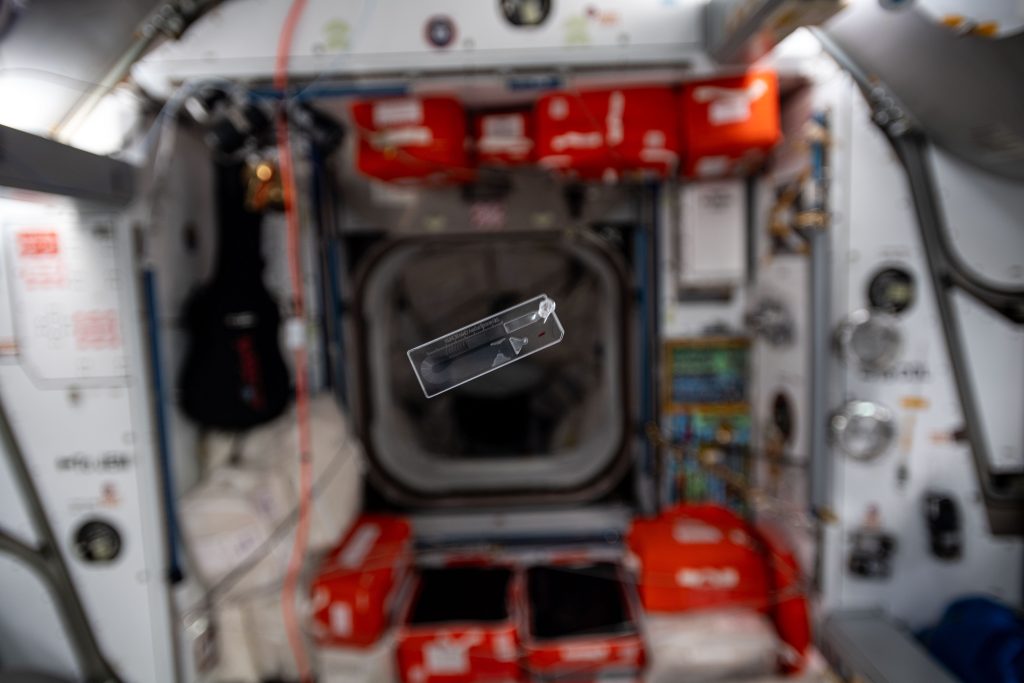
TRL9 Microfluidics – Axiom Space Ax-4 mission, International Space Station Design, develop, manufacture and test autonomous zero G Microfluidics for space applications
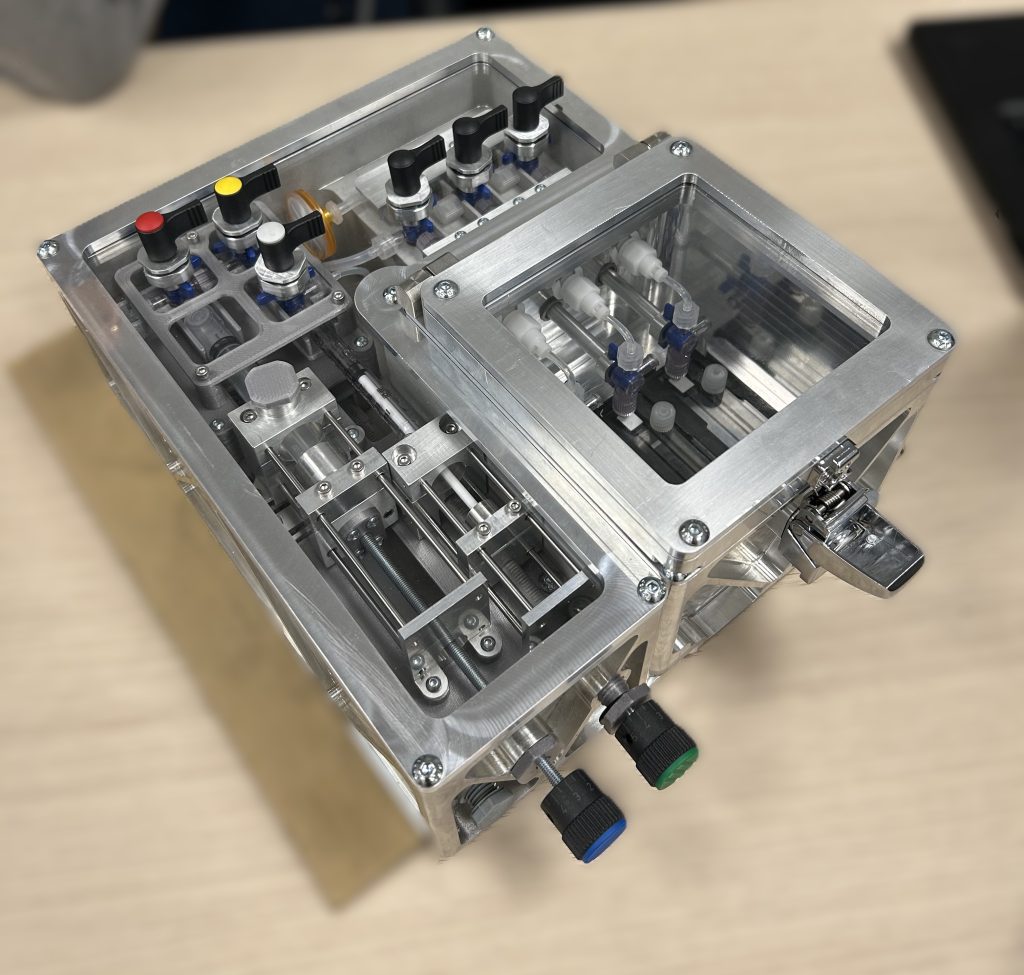
Payload development for ISS experiments
Conducting research on the International Space Station requires hardware that is safe, reliable, and easy for astronauts to operate. We design and build customized experiment containers and sample preparation units for microgravity research. Our payloads enclose critical steps—such as mixing reagents, fixing biological samples, or thermally cycling reactions—so that science runs smoothly with minimal crew intervention. We handle the entire development process, from concept and mechanical design to qualification testing and flight-ready delivery, ensuring compliance with strict ECSS quality and ISS safety and operational standards.
Miniature propulsion components
Small satellites need propulsion systems that are compact, light, and efficient—and micro-technology makes this possible. Our precision microfabrication capabilities allow us to produce miniature valves components with micron-tolerance sealing surfaces, ensuring ultra-low leakage and fast response times. We apply advanced micro-machining and laser technologies to create cathodes with precisely controlled emitter surfaces. Micro-structuring enables complex internal geometries that optimize performance within a fraction of the volume of conventional parts. By shrinking critical components without sacrificing reliability, our micro-engineering approach helps satellite manufacturers save mass, reduce power, and extend mission lifetimes.